
Fun is not the opposite of serious
Client:
Bambynos Social Media Agency · 2025
Fun is not the opposite of serious
Industry:
Social media marketing
Services provided:
Brand identity · Visual system · Collateral

THE BRIEF
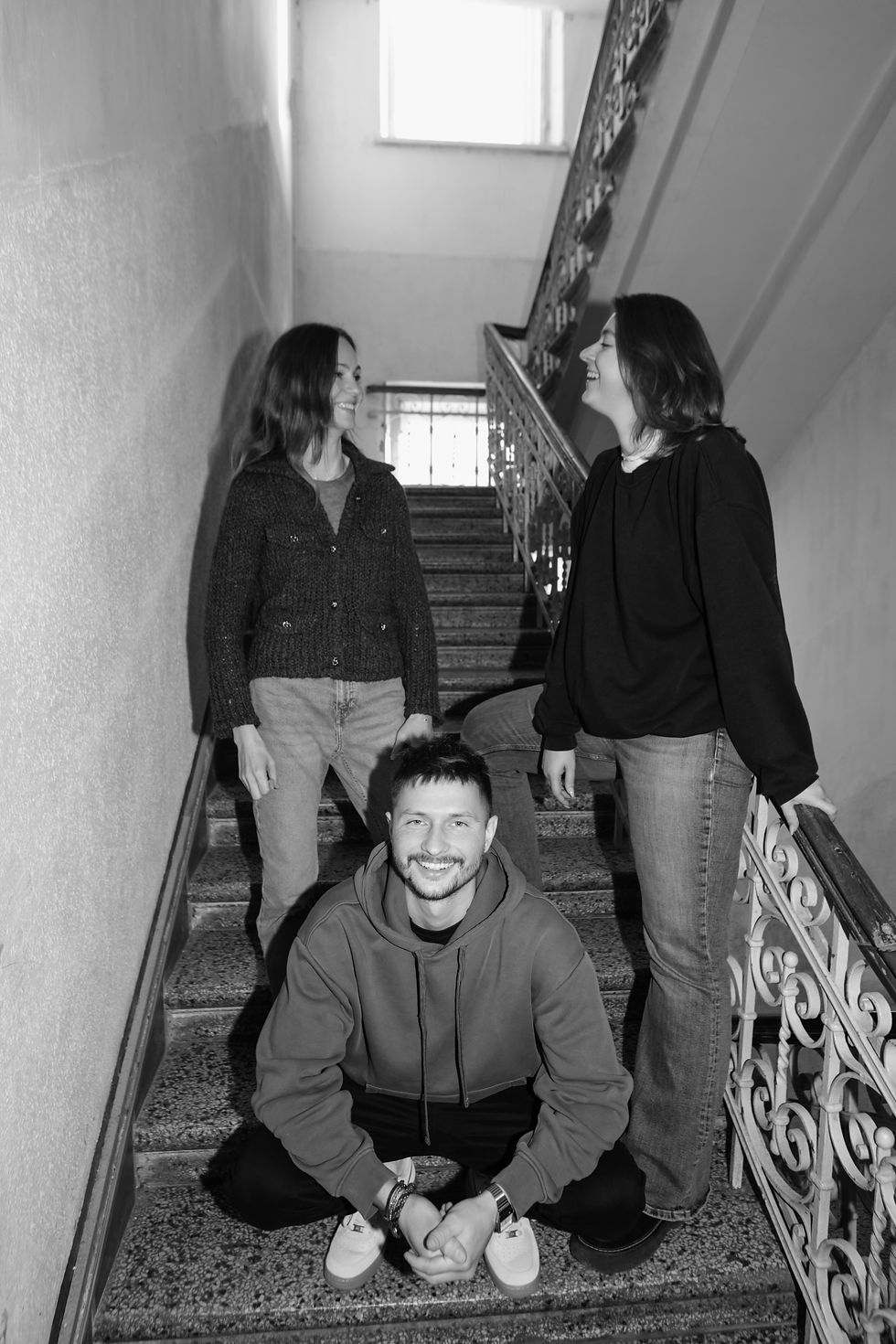
Bambynos is a full-service social media agency run by three young women: strategy, content, production, community management, and paid campaigns. They work closely with their clients and are often the ones in front of the camera, so their character isn’t a wrapper around the service; it’s part of it.
They came to NR3 to build the brand identity from the ground up: logo, visual system and collateral. The name holds the first half of the brief. Bambynos comes from bambino, the child: free creativity, play before self-editing, curiosity ahead of caution, carried into the language of social media and technology the agency lives in.
The second half arrived in a single sentence: keep our character, but make people take us seriously. Young women in business are routinely underestimated, and no amount of good work undoes a judgement made in the first few seconds. The credibility was already there; the brand had to carry it.
Insight
Put the two halves together, and they look like a trade: the more seriously you want to be taken, the less of your character you’re supposed to show. Most brands in this position pay it. They go grey, go minimal, borrow the visual codes of the corporate world and hope credibility comes with them. It rarely does. It strips out the personality clients are buying, and it accepts the premise behind the problem - that to be taken seriously, young women should look less like themselves.
The bias is well documented. A 2023 study in Frontiers in Psychology - two preregistered experiments, over 1,900 participants - found a consistent negative bias in the leadership status ascribed to young leaders, with young age proving a strong enough signal to overshadow gender. Kanze et al. (Academy of Management Journal, 2018) filmed investors questioning 189 startups and found men were asked how they would win while women were asked how they would avoid losing. The founders who were asked the first kind of question went on to raise seven times more. A 2025 randomised-response survey of 361 venture capitalists found 26.9% think women’s participation in founding teams is overrated, and 11.9% would not invest in a women-led venture at all.
It is measurable, and it is pre-rational. It works in the first few seconds, before a proposal is read or the team is met. Those seconds are exactly what a brand controls.
Seriousness in a brand does not come from being plain. It comes from rigour.
So we refused the trade. The character stays in full, on an engineered foundation. A brand reads as credible when it is evidently well-built: a system that holds a logic behind every decision. Play can sit on top of that, it cannot stand in for it.


The approach
The B
The mark takes its cue from the Barbie wordmark - one of the most recognisable pieces of feminine-coded design ever made, and one that has had an eventful decade. For most of its life it stood for a narrow, unserious idea of what a woman should be. Since 2023 it has become something people claim on purpose. It is also a toy. Both halves of the brief are already sitting in that one object: the child, and femininity as a position rather than a liability.
Our B is drawn from scratch: the confident curve and instant readability of that lineage, rebuilt on a strict geometric grid rather than a hand-drawn script. Familiar feeling, engineered construction - legible in a circular profile frame, as a favicon, on a sticker, at 16 pixels.
Violet and yellow
A true complementary pair: opposite on the colour wheel, the maximum contrast two hues can generate. Yellow is the most luminous colour in the spectrum, violet among the darkest, which gives the system a full tonal range from two colours alone. Violet carries depth and authority; yellow is energy and immediate attention. Neither softens the other.
The two halves: held in tension rather than blended into a compromise.
The pixel
The pixel is the indivisible unit of a digital image: the easiest thing in the world to dismiss on its own, and the thing every screen image is entirely made of. Great ideas can start from a single pixel. For an agency of three, that is the argument itself - scale is not what makes something substantial.
A pixel is also a block, and blocks are what children build with. It is the childhood reference in the name, translated into the native material of the platforms.
It also does the structural work. A pixel is a grid, and the grid is what makes the identity feel engineered rather than improvised. The logo expands into a flexible pattern system where variation is a rule being played with, not decoration applied on top. It was built in the same geometry the platforms use, so it holds across square feed grids and circular profile frames instead of being cropped into them - and carries off-screen to stickers, neckerchiefs and tote bags without translation loss.
This is where the fun and the seriousness stop competing.


Results
No identity corrects the numbers above. That is not what design does. But the bias they describe operates in the opening seconds of an encounter - the one part of the problem a brand genuinely owns.
Bambynos did not need a brand that argued they should be taken seriously. They needed one that stopped the question being asked. The character is all still there, undiluted. It is simply built on something that holds under weight.
Design cannot remove a bias. It can refuse to accommodate it.
Testimonial
„Jei nori didžiuotis savimi - daryk darbus, kuriais galėtum didžiuotis. Ši komanda yra tai, kuo galima didžiuotis <3“
“If you want to be proud of yourself - do work you could be proud of. This team is something to be proud of.”
Ieva Loibaitė
Co-Founder, Bambynos


Sources
Daldrop, C., Buengeler, C. & Homan, A. C. (2023). An intersectional lens on young leaders: bias toward young women and young men in leadership positions. Frontiers in Psychology. frontiersin.org/journals/psychology/articles/10.3389/fpsyg.2023.1204547/full
Kanze, D., Huang, L., Conley, M. A. & Higgins, E. T. (2018). We Ask Men to Win and Women Not to Lose: Closing the Gender Gap in Startup Funding. Academy of Management Journal. hbs.edu/faculty/Pages/item.aspx?num=54068
Koch, L. H., Berger, E. & Kuckertz, A. (2025). Gender bias and discrimination towards women entrepreneurs by venture capitalists - a randomized response survey. Venture Capital. tandfonline.com/doi/full/10.1080/13691066.2025.2493049
VISIT US
A. Juozapavičiaus g. 6, Vilnius, 09311
©2025 NR3.STUDIO
JOIN OUR NEWSLETTER
Leave us with your email to get updates from the studio.
You're all set! You’ll be hearing from us soon.